Edwin Beard Budding: The Man Behind the Modern Pitch
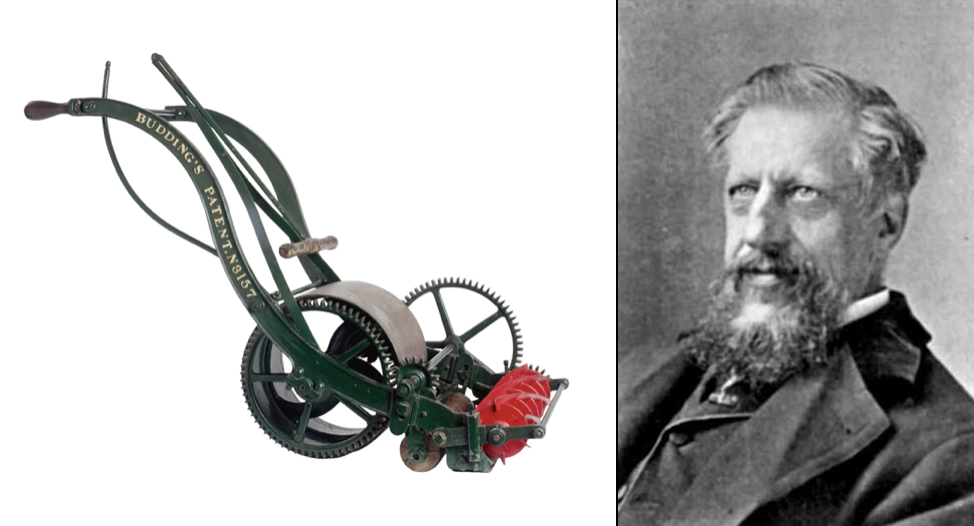
Would the Premier League exist without Edwin Beard Budding?
Modern sport depends on carefully prepared playing surfaces. Yet until the nineteenth century, they were almost impossible to achieve.
Keeping grass short was slow, exhausting work. It was cut with scythes or grazed by sheep. The result was uneven, unpredictable and difficult to maintain. Large, smooth lawns were a luxury few could afford.
In 1830, a mill engineer from Stroud had an unlikely idea. While watching machinery in a local cloth mill, Edwin Beard Budding noticed a rotating cylinder of blades shaving the rough fibres from woven wool to leave it with a smooth finish. He realised the same principle could work on grass. Instead of cutting cloth, why not shave a lawn?
On 31 August 1830, he patented the world’s first practical lawnmower.
As the machine was pushed forwards, a rear roller drove a cylinder of rotating blades through a set of gears. Those blades sliced cleanly against a fixed cutting edge, producing an even cut that a scythe could not match. Early models cut a strip just nineteen inches wide and collected the clippings in a tray at the front.
Within a few years, Budding’s mowers were being used in places such as the Regent’s Park Zoological Gardens and the colleges of Oxford. As the machines improved, carefully maintained grass was no longer confined to aristocratic estates. Parks, schools, sports clubs and eventually ordinary homes could all enjoy level, closely cut lawns. That mattered far beyond gardening.
Cricket pitches became more consistent. Tennis evolved from an irregular pastime into a game played on carefully prepared courts. Football clubs could maintain reliable playing surfaces throughout an entire season. The immaculate playing surfaces that have become one of the defining images of modern sport owe their existence to the humble cylinder mower that Budding devised almost two centuries ago.
His invention also helped shape the appearance of towns and suburbs worldwide. The neatly trimmed lawn became a familiar feature of public parks, village greens and family gardens, maintained by a machine whose basic cutting principle remains largely unchanged today.
Edwin Beard Budding died in 1846 at the age of fifty. His name is little known outside engineering circles. Yet every professional football match, cricket fixture and tennis tournament played on natural grass still relies on the cutting principle he patented in 1830.
Further reading
Two Men Went to Mow: The Obsession, Impact and History of Lawn Mowing by Clive Gravett