Claudette Colvin: The Schoolgirl Who Refused to Stand
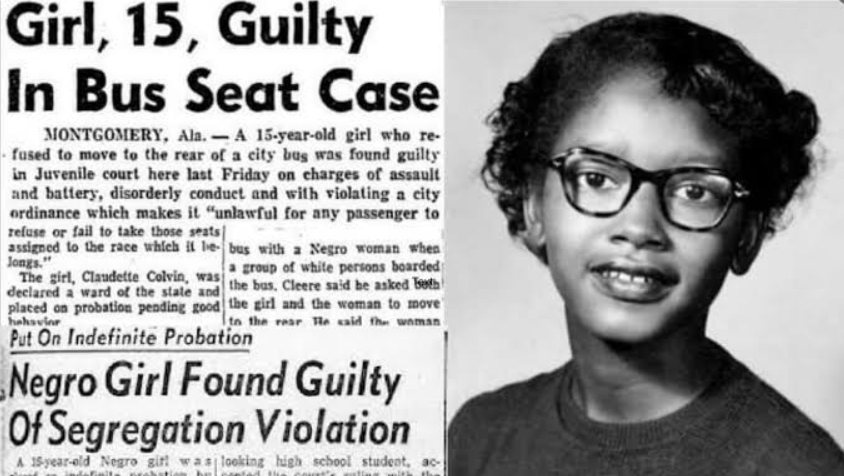
On 2 March 1955, a 15-year-old schoolgirl refused to give up her seat on a segregated bus in Montgomery, Alabama.
Nine months later, Rosa Parks would refuse to give up her seat on another Montgomery bus, becoming one of the defining figures of the American civil rights movement.
In 1955, Alabama’s buses were segregated by law. Black passengers paid the same fare as everyone else but could be ordered to surrender their seats whenever the white section filled. Refusing was a criminal offence. For the thousands of black residents who relied on Montgomery’s buses each day, it was a daily reminder of segregation.
When the driver told the 15-year-old to move, she refused.
Police were called. They pulled the schoolgirl from her seat, dragged her off the bus, arrested and handcuffed her.
The schoolgirl’s name was Claudette Colvin.
“History had me glued to the seat.”
Civil rights leaders considered using Colvin’s arrest to challenge bus segregation in Montgomery.
They decided against it.
A few months after her arrest, Colvin became pregnant while unmarried. Civil rights leaders feared opponents would use her personal circumstances to discredit the wider cause. When Rosa Parks was arrested later that year, they believed her case offered the strongest public test of Montgomery’s segregation laws.
In 1956, Colvin became one of four plaintiffs in Browder v. Gayle, the federal lawsuit challenging bus segregation in Alabama.
Colvin was still only 16 when she testified before the three-judge federal panel. The judges ruled that bus segregation was unconstitutional. The United States Supreme Court upheld the decision, bringing legal segregation on Montgomery’s buses to an end.
Rosa Parks helped ignite the boycott.
Claudette Colvin helped win the case that ended bus segregation.
For decades, Colvin’s role was largely unknown beyond civil rights history. She spent much of her later life working as a nurse aide in New York while others were remembered.
It was not until 2021, more than 66 years after her arrest, that an Alabama court formally expunged Claudette Colvin's juvenile record.
Suggested by Tony Small
Further reading
Claudette Colvin: Twice Toward Justice by Phillip Hoose