Eugene Polley: The Man Who Pressed Our Buttons
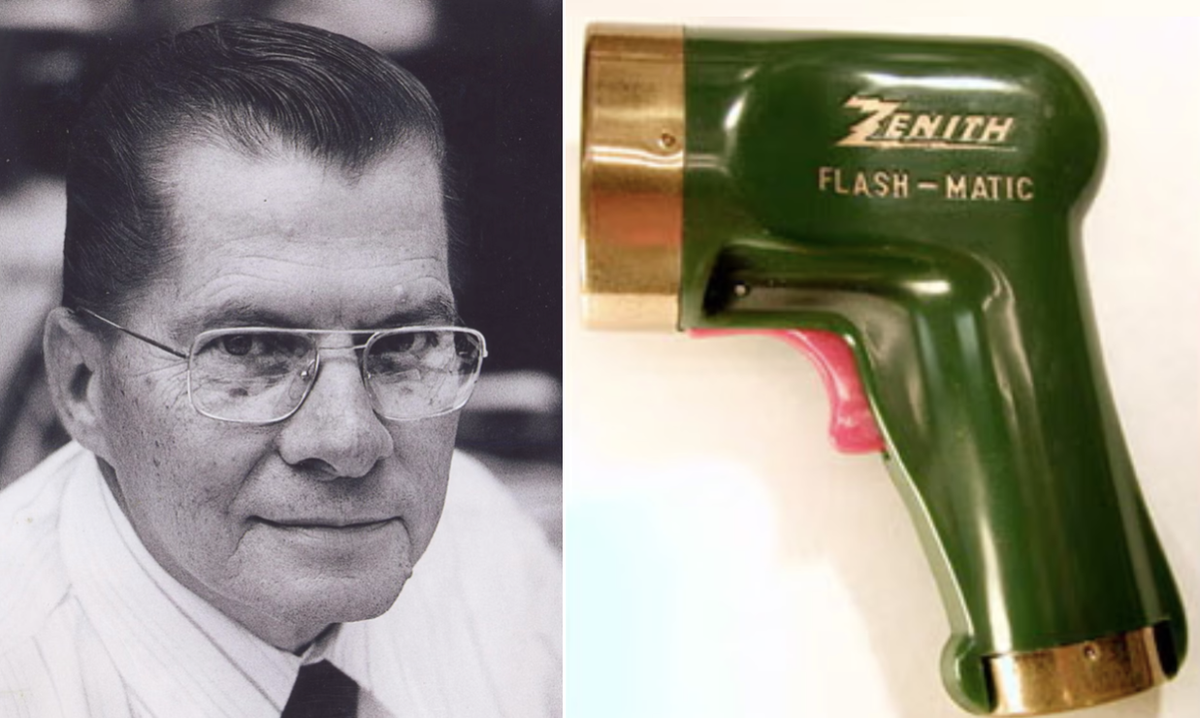
Few everyday objects cause as much domestic friction as the television remote control.
Disappeared. Who hid it? Found. Evening saved! Have remote, will dictate evening.
There was a time when nobody owned a TV remote.
In 1950s America, changing channel meant getting out of your chair and walking across the room. Chicago television manufacturer Zenith tried a wired remote called the Lazy Bones. The cable trailing across the carpet became an irritation of its own.
Eugene Polley found another way.
Polley joined Zenith in 1935 as a stock boy before moving into engineering, where he worked on wartime radar and car radios. In 1955, he turned his attention to television.
His idea was the Flash-Matic.
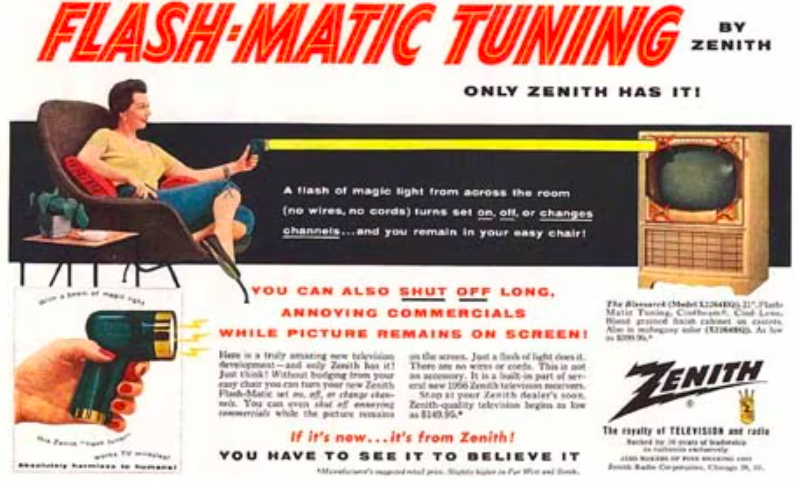
The pistol-shaped device fired a beam of visible light at four sensors around the television screen. Aim at the right one and you could switch the set on or off, mute the sound or change channel.
It was the world’s first wireless television remote control.
It wasn’t perfect. Sunlight could trigger the sensors. Fellow Zenith engineer Robert Adler later replaced light with ultrasonic sound. The more reliable system became the standard for decades.
But Polley had proved the idea worked.
The remote changed how people watch television. Viewers can flick between programmes, silence adverts, pause, rewind and fast-forward from their armchair.
In recent years, voice activation and motion sensors have been touted as replacements. Neither has displaced the remote. But the way we watch is changing. Families are less likely to gather around a single television. Smartphones and tablets increasingly do the job instead.
Polley’s idea remains everywhere.
We unlock cars, open garage doors, control lights and adjust heating from a distance. Technology comes to us.
The TV remote may disappear, but Eugene Polley gave us control.
Further reading
Channel Surfing Redux: A Brief History of the TV Remote Control and a Tribute to Its Coinventors (PDF) by Wayne C. Luplow and John I. Taylor