Grady Martin: The Man Who Found Music in Noise
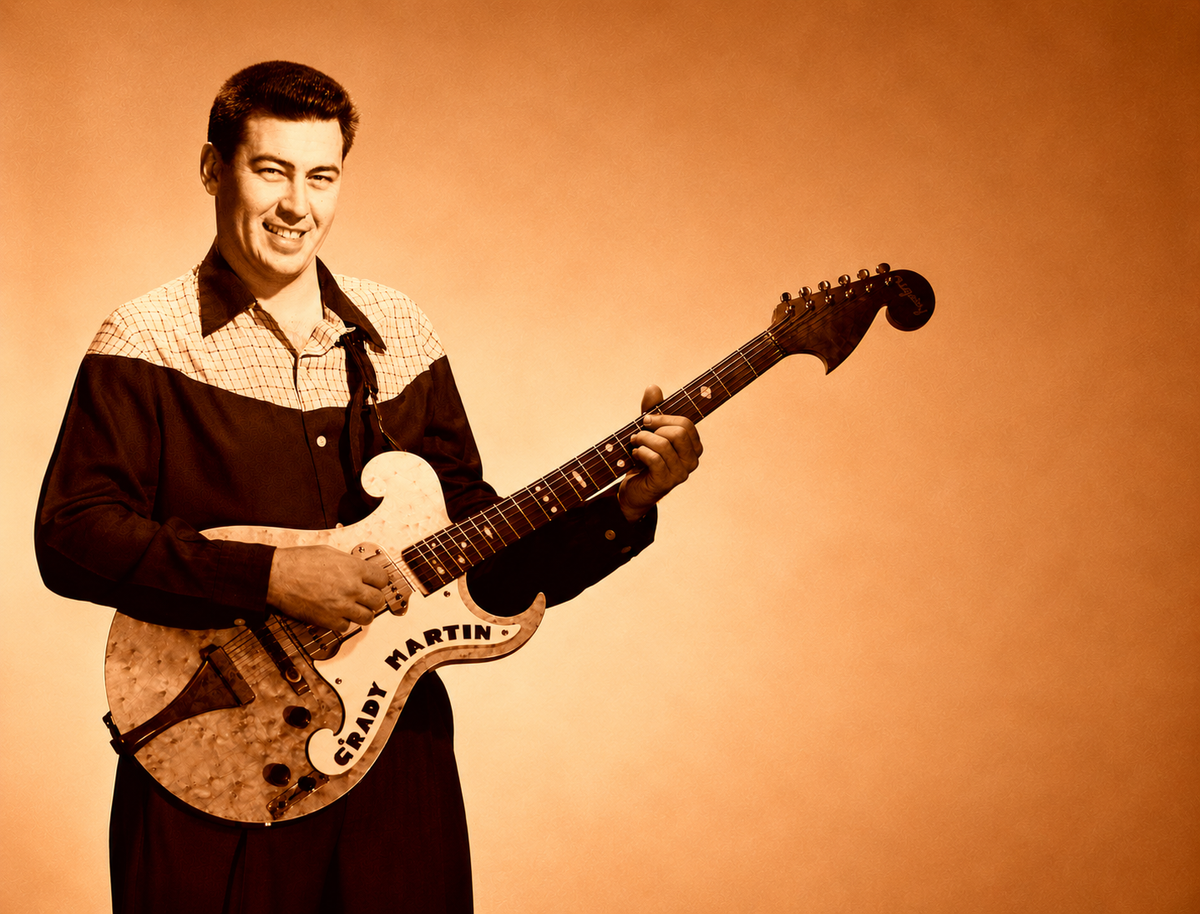
Before 1960, electric guitars were expected to sound clean.
If musicians wanted a rougher, more aggressive sound, they had few reliable options. Some pushed their amplifiers beyond their intended limits. Others experimented with damaged speaker cones to create a harsher tone. The results could be exciting, but they were difficult to control and almost impossible to reproduce consistently.
Then, by accident, everything changed.
In late 1960, Nashville session guitarist Grady Martin was recording ‘Don’t Worry’ with country singer Marty Robbins. During the session, a fault somewhere in the recording chain caused Martin’s guitar to produce an unusual, distorted sound. Accounts differ on the precise cause, but it is generally believed to have involved a defective component in the studio’s mixing equipment.
Not everyone liked what they heard.
Robbins reportedly wanted the sound removed, but Martin and recording engineer Glenn Snoddy thought it was interesting. In the end, the distorted guitar part remained on the record. Around halfway through the song, listeners heard a sound unlike anything that had appeared on a hit record before.
When ‘Don’t Worry’ became a success in 1961, musicians and recording engineers began asking how the effect had been achieved. Snoddy, Martin and others realised they had stumbled across something new. Rather than dismissing the distortion as a technical fault, they explored ways to recreate it deliberately.
The discovery caught Gibson’s attention. Working with Snoddy and engineer Revis Hobbs, the company developed a device that could reproduce the effect on demand. The result was the Maestro FZ-1 Fuzz-Tone, widely regarded as the first commercially successful guitar fuzz pedal. Initially, interest was modest.
Then, in 1965, Keith Richards used a Fuzz-Tone on the opening riff of ‘(I Can’t Get No) Satisfaction’. Richards had imagined the riff as a temporary guide for a horn section, but the recording was released with the distorted guitar intact. The song became a worldwide hit and demand for fuzz pedals soared.
Soon rival devices appeared, including the Tone Bender, Fuzz Face and Big Muff. Distorted guitar sounds became a defining feature of rock music and would influence generations of musicians.
The musician and producer Brian Eno, best known for his work with Roxy Music and for producing artists such as David Bowie and U2, once observed that the things we initially dismiss as flaws often become the defining features of a new medium. The story of the distorted guitar proves the point. What began as a fault in a recording console became one of the most influential sounds in modern culture.
Today, the guitar effects industry is worth billions of dollars. The sound that Grady Martin first chose to embrace gave generations of musicians a new musical vocabulary with which to express anger, excitement, rebellion, longing and joy. By recognising possibility where others heard only a fault, Martin helped transform a technical failure into one of the defining sounds of modern music.
Further reading
Play It Loud: An Epic History of the Style, Sound, and Revolution of the Electric Guitar by Brad Tolinski and Alan di Perna
Grady Martin's distorted guitar can be heared at 1:25