Pierre Bézier: The Man Who Taught Computers to Draw
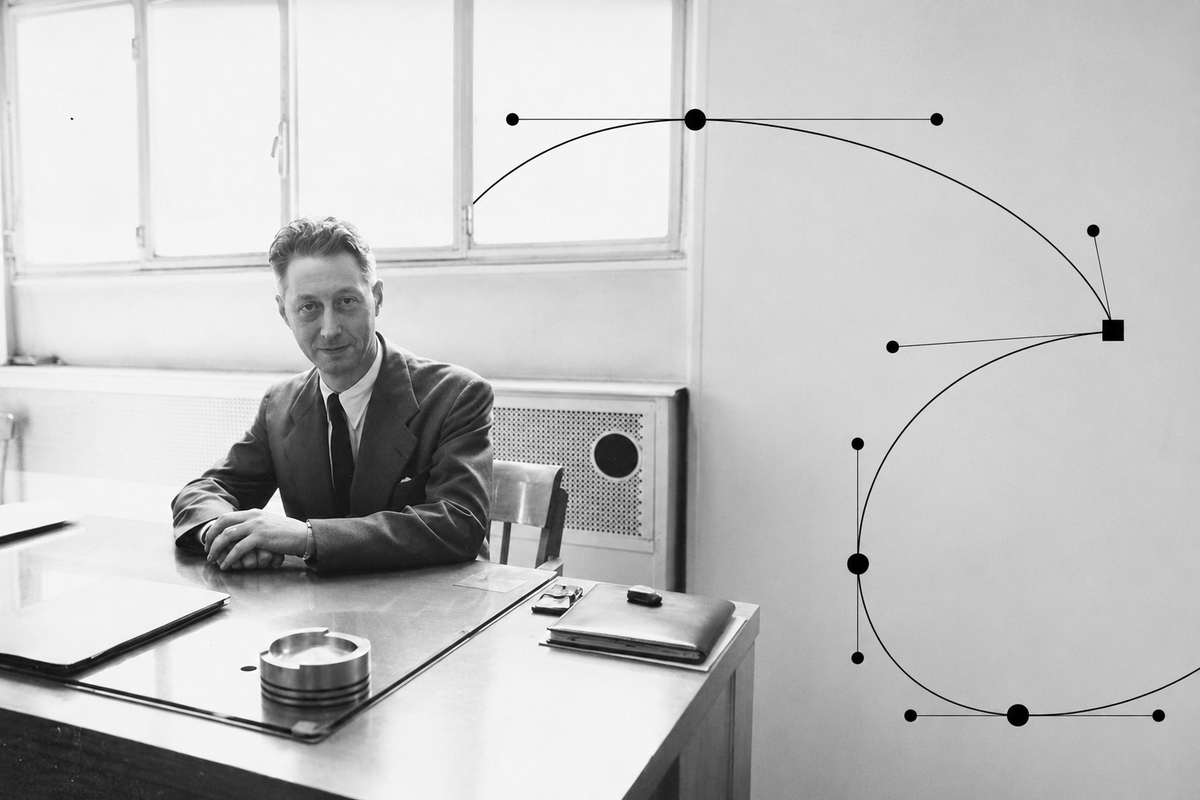
The modern world is full of beautiful curves.
The lines of a car, the outline of a logo, the letters on a page, the icons on a phone screen and the animations we watch all depend on smooth, flowing curves.
Born in France in 1910, Pierre Bézier spent much of his career as an engineer at Renault. By the 1950s, manufacturers began using computers to design and build products. Most people saw them as machines for calculations and repetitive tasks. Bézier saw something different. He believed computers could become creative tools.
But turning that belief into reality meant overcoming a significant challenge. Car designers still relied on full-size drawings, templates and clay models. Altering a design often meant hours of painstaking redrawing or reshaping. Bézier believed there had to be a better way.
Bézier found one. While working at Renault, he developed a method that enabled computers to create smooth, flowing curves that designers could alter quickly and precisely. What began as a solution for one car company soon escaped the factory. Bézier’s curves became one of the foundations of computer-aided design, digital typography, animation and graphic design. Architects use them to shape buildings. Graphic designers use them to create logos, illustrations and typefaces. Engineers use them to design products of almost every kind.
The idea itself was elegantly simple. Instead of telling a computer where every point on a curve should be, a designer only needed to position a handful of control points. The computer calculated the graceful curve between them. Hours of painstaking redrawing became mere moments.
His achievement was not creating beautiful designs himself. It was giving millions of other designers a remarkably simple tool with which to create, refine and perfect their own. In doing so, he helped preserve the human touch as design entered the digital age.
The next time you unlock your phone, look at the icons on the screen. Their rounded corners, graceful curves and visual balance are not there by accident. They are part of a design language that traces its roots back to Bézier’s work. Every time a designer perfects the shape of a letter, a logo or an app icon, they are building on the idea he pioneered.
Few people have done more to shape the visual language of modern life than Pierre Bézier.
Further reading
Curves and Surfaces for Computer-Aided Geometric Design by Gerald Farin