Srinivasa Ramanujan: The Indian Clerk Whose Mathematics Shapes Your Life
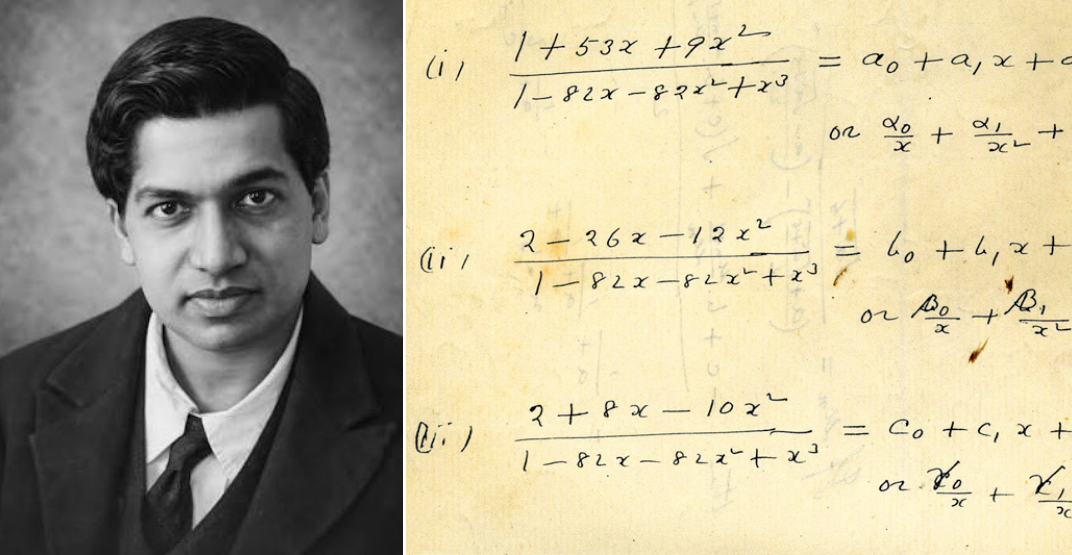
On 31 January 1913, renowned Cambridge mathematician G. H. Hardy opened a letter from India.
Inside were pages covered in equations. Just result after result. The sender was Srinivasa Ramanujan, an unknown clerk working in Madras.
He had no university degree and had taught himself most of the advanced mathematics he knew. Earlier efforts to interest leading mathematicians in his work had come to nothing.
Hardy looked more closely.
Some of Ramanujan’s results were already known, although they had taken accomplished mathematicians years to discover. Others were completely new. Hardy later admitted that some had “defeated me completely”.
Born in southern India in 1887, Ramanujan showed an extraordinary gift for numbers from an early age. As a teenager, he borrowed G. S. Carr’s A Synopsis of Elementary Results in Pure and Applied Mathematics, a book containing thousands of results but very few explanations. Ramanujan worked through them on his own, then began developing original results.
He neglected every other subject and lost the scholarship that would have funded university. After periods of poverty and unemployment, he found work as a clerk at the Madras Port Trust.
In 1914, Hardy arranged for Ramanujan to come to Cambridge.
Over the next five years, he made major advances in number theory, infinite series, continued fractions and mathematical analysis.
In 1918, he became one of the youngest Fellows of the Royal Society. That same year, he became the first Indian elected a Fellow of Trinity College, Cambridge.
Ramanujan returned to India in 1919. He died the following year, aged 32, probably from complications of dysentery.
Ramanujan recorded nearly 3,900 mathematical results. Mathematicians would spend decades proving them and building on his ideas.
In 1976, mathematician George Andrews found a collection of Ramanujan’s papers in Trinity College’s library. The collection contained work from the final year of his life and became known as his ‘lost notebook’.
Ramanujan’s mathematics shapes our lives in unexpected ways:
- Secure digital communications, through mathematics used in cryptography and the development of post-quantum security.
- Digital signals and images, where Ramanujan sums help identify repeating patterns and recover information damaged by noise or lost data.
- Faster computation, through the Hardy–Ramanujan–Rademacher formula, which allows enormous partition numbers to be calculated efficiently.
- Our understanding of black holes, where mathematics descended from his mock theta functions is used to count their quantum states.
- High-precision computing, through Ramanujan’s fast-converging formulae for calculating π to an enormous number of decimal places.
- Modern mathematics itself, where his ideas continue to open new lines of research.
More than a century after his death, mathematicians are still proving theorems Ramanujan simply wrote down.
Further reading
The Man Who Knew Infinity: A Life of the Genius Ramanujan by Robert Kanigel